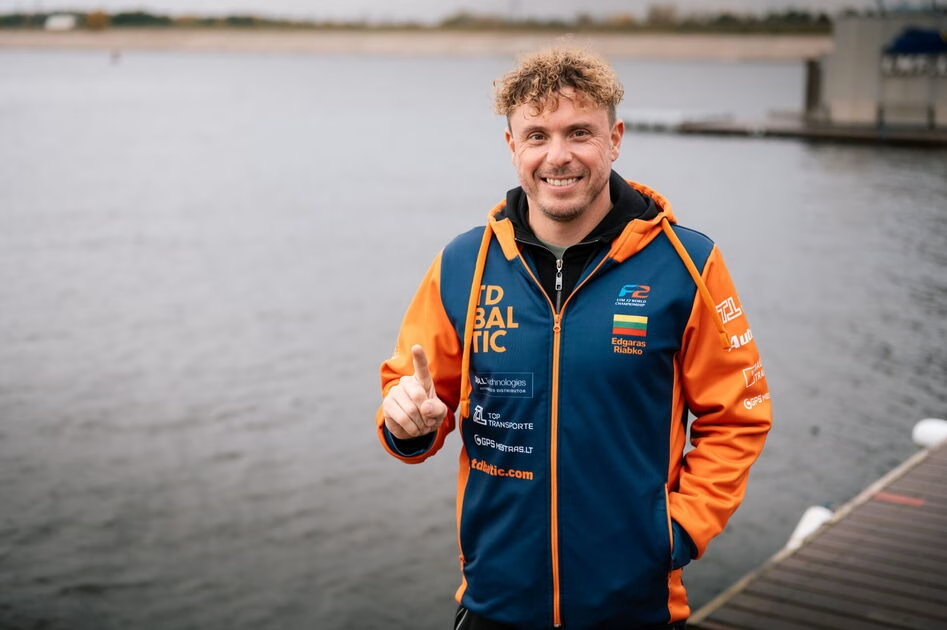
Kaunas, known as the cradle of Lithuanian sports, boasts deep traditions in various sports, including water sports. For decades, the Nemunas River and the Kaunas Lagoon have served as vital spaces for athletes’ training and competitions. New talents emerge here, and experienced athletes strive for top results both in Lithuania and abroad. Kaunas resident Edgaras Riabko is one such athlete bringing international acclaim to the city.
This year, Riabko clinched the F2 water formula world champion title in Portugal. Beyond his personal achievements, he is dedicated to fostering the future of this sport in Lithuania, creating opportunities for the younger generation to discover it.
Edgaras Riabko shares more about his journey to the world championship title, the perilous moments on the race track, nurturing young athletes, and his love for Kaunas.
How did your journey in powerboating begin?
I’ve been involved in this sport for a very long time. This sport used to be significantly more popular in Lithuania, with more clubs and places for children to train. Kaunas also had powerboating clubs, athletes trained in the Kaunas Lagoon, Lampėdžiai, and on the Nemunas River, and competitions were held in Birštonas. After Lithuania regained its independence, much changed. Some clubs disappeared, the previous infrastructure vanished, and pursuing this sport required much more personal initiative.
I gradually progressed through different classes, gained experience, and aimed for results. Later, responsibility for the entire sport emerged. Initially, I was reluctant to take on the role of federation president. I was still actively racing, at a stage in my athletic career where I wanted to focus solely on my own results. However, I realized that if no one took the initiative, the situation wouldn’t improve on its own.
Is that how the desire arose not only to race yourself but also to create conditions for others?
Yes. When you see that children have nowhere to go, no opportunity to try out the equipment, you start thinking about what you can do yourself. Simply talking about the sport lacking attention is not enough. Solutions, people, and a location must be found, and time and sometimes personal funds must be invested. I wanted powerboating in Lithuania not only to survive but also to have a future, so that children could come, try it out, understand if they like it, and then decide if they want to pursue it further.
During the pandemic, you started developing a powerboating base in Kaunas. Where did it all begin?
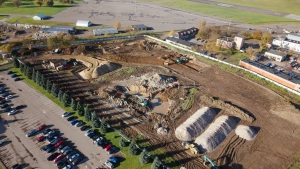
We started practically from scratch. The area was not prepared for sports, and everything had to be created anew. We did a lot ourselves: tidied up the area, looked for solutions on how to set up the base so that children could train there. There were personal investments and a lot of manual labor, but when you have a goal, you don’t count your strength.
The most important thing was to create a place where children could come not just to look at the boats, but to actually learn to handle a powerboat. I wanted them not to need all the equipment right away. If everyone had to buy a boat, helmet, life jacket, and everything else needed first, many wouldn’t even have the chance to try.
What do the first steps of children in this sport look like today?
At the academy, we provide children with what they need to start. They have boats, helmets, life jackets, coaches, learn to behave safely on the water, and are introduced to the technology. They can come and try if they like the activity, rather than immediately asking their parents for huge investments. It’s important to me that they can train and improve, and that everything doesn’t depend on whether the family can afford their own equipment. The greatest euphoria comes when children who recently learned their first maneuvers later stand on the podium.
You became world champion. What was your first feeling?
Very strange. You would think you should be happy, as you have persistently strived for it for many years. However, a sense of bewilderment came first, and thoughts began to swirl in my head: is this the end, what will I do next? When you strive for one goal for a long time, it becomes part of your daily life. Before falling asleep, you think about the start, imagine how you will win, and what the moment will look like. And when it finally happens, it’s initially hard to grasp that the dream has become a reality.
The euphoria was greater when I became European champion for the first time. That time I felt immense joy, it felt like I would burst with happiness, whereas after the world championship gold, I felt a bit lost. Of course, I was happy, but that came later, when I realized I didn’t want to stop and wanted to defend the title again.
Have you experienced much disappointment before this title?
Of course. Over the years, there has been everything – victories, second and third places, technical problems, and situations where the result doesn’t depend solely on you. I have won European Championship gold, silver, and bronze medals, and I had also won medals at world championships before finally achieving first place.
Sometimes it seems like you work so hard, get so close, but the gold is still missing. However, every competition provides experience, and sports teach you not only to win but also to lose. First, you must applaud another to be applauded yourself, and if you give up after a failure, you will achieve nothing.
During your career, have you received offers to join stronger foreign teams?
After winning the European Championship, I received offers from Italian and Portuguese teams. As an athlete, you always want to be where the best equipment, strongest people, and greatest opportunities are. However, at the highest level, everything doesn’t depend solely on talent. Manufacturer teams have large budgets, advanced equipment, and more opportunities to improve it.
If you are a privateer athlete, competing with such resources is very difficult. Sometimes I like to joke that it’s better to be a star in the EuroLeague than to sit on the bench in the NBA. For me, it’s not just about the team I represent, but also whether I can realistically fight for victories.
Powerboating looks impressive from the outside, but also dangerous. Have there been moments when you encountered danger?
Yes, in 2014, during a competition in Latvia, I had a serious accident. I collided with another boat, capsized in the water, and couldn’t get out. Everything happened very quickly, and it wasn’t easy to free myself because the safety mechanism didn’t work as it should – the strap got stuck. In such situations, you stop thinking about results; entirely different thoughts come to mind.
I remember that moment very vividly, with thoughts of my family, of the need to return to them. After such incidents, of course, fear remains; you realize that even one mistake can have serious consequences, but over time it subsides, and you return to racing.
Do you have any rituals or traditions before competitions?
My team and I have an old tradition. There was a period when we were very unlucky, as if something was always hindering us. Finally, during one trip, my team and I decided not to shave our beards during the competition weekend. Joking aside, but from that moment on, things started going well. I don’t know if it’s the beards’ fault or just a coincidence, but the tradition stuck. Since then, whenever we go to a competition, the whole team and I don’t shave our beards during the journey.
A wish for Kaunas.
I am a Kaunas resident myself and admire my city every day, so I wish Kaunas to continue to grow and beautify itself consistently and to be the best city in Lithuania. We have many opportunities here; we just sometimes don’t appreciate them enough ourselves.