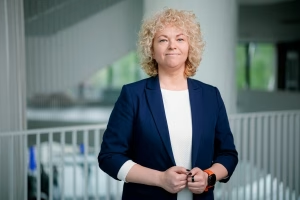
Professor Dr. Inga Dailidienė from the Klaipėda University (KU) Sea Research Institute has been elected Chairwoman of the National Climate Change Committee (NKKK) for a three-year term. The committee she leads will provide independent scientific advice to the Ministry of Environment on climate change policy formulation, assessment, and implementation.
„There is a lot of work ahead, but climate change research has been my long-term area of activity. At Klaipėda University, my colleagues and I are researching how the Baltic Sea and its coastlines are changing – from sea-level rise to more frequent marine heatwaves. These studies help us understand what changes we can expect and how to prepare for them. Leading the committee, I will strive to ensure that this accumulated experience, along with the knowledge of other Lithuanian scientific institutions, is utilized in making climate policy decisions,” says Prof. Dr. Inga Dailidienė from the KU Sea Research Institute.
According to her, the committee’s work is particularly important as Lithuania prepares to assume the Presidency of the Council of the European Union in the first half of 2027.
„Scientists’ participation in these processes will be crucial. We will strive to ensure that scientists are not left aside: they are more actively involved in discussions and decision-making, and their knowledge is used in shaping climate policy,” states Prof. Dr. I. Dailidienė.
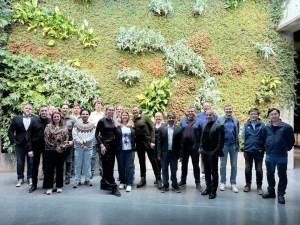
The new term committee will include scientists delegated by 11 Lithuanian science and study institutions. Five members from the previous term will continue their work, including Prof. Dr. I. Dailidienė, while six members have been newly appointed. This composition allows for the retention of accumulated experience while incorporating new competencies and perspectives.
At the new term NKKK meeting, Lithuania’s preparations for the EU Council Presidency in the first half of 2027 and the implementation of the new Climate Change Adaptation Law were discussed.
The committee’s purpose is to help ensure that climate policy decisions are based on the latest scientific knowledge, reliable data, and independent expert assessment. The NKKK evaluates climate change research, conclusions from the Intergovernmental Panel on Climate Change (IPCC), and other relevant scientific information. The committee can also provide recommendations on research and funding priorities, assess greenhouse gas accounting, forecasts, and the impact of climate policy measures.
„Climate policy must be science-based, so scientists’ insights are valuable to us right from the beginning of the decision-making process – not only in assessing prepared proposals but also in shaping their direction. I thank the members of the previous term committee for their contribution and congratulate the new members – I hope for open, consistent dialogue in addressing both current and long-term climate policy issues,” says Deputy Minister of Environment Aira Paliukėnaitė.
During the new term, the Ministry of Environment will seek to more actively utilize the committee’s expert competence. Scientists’ insights will be important both in assessing decisions being prepared and in earlier stages of policy formulation – in identifying problems and analyzing possible solutions.