Kaunas is rapidly changing in recent years and is undergoing one of its most significant transformations. Ambitious projects are being implemented in the city, public spaces are being renovated, and new neighborhoods are being developed. One of the most important highlights today is the M. K. Čiurlionis Concert Center, which will become not only a new point of attraction but also another important step in the city’s reorientation towards the Nemunas River.
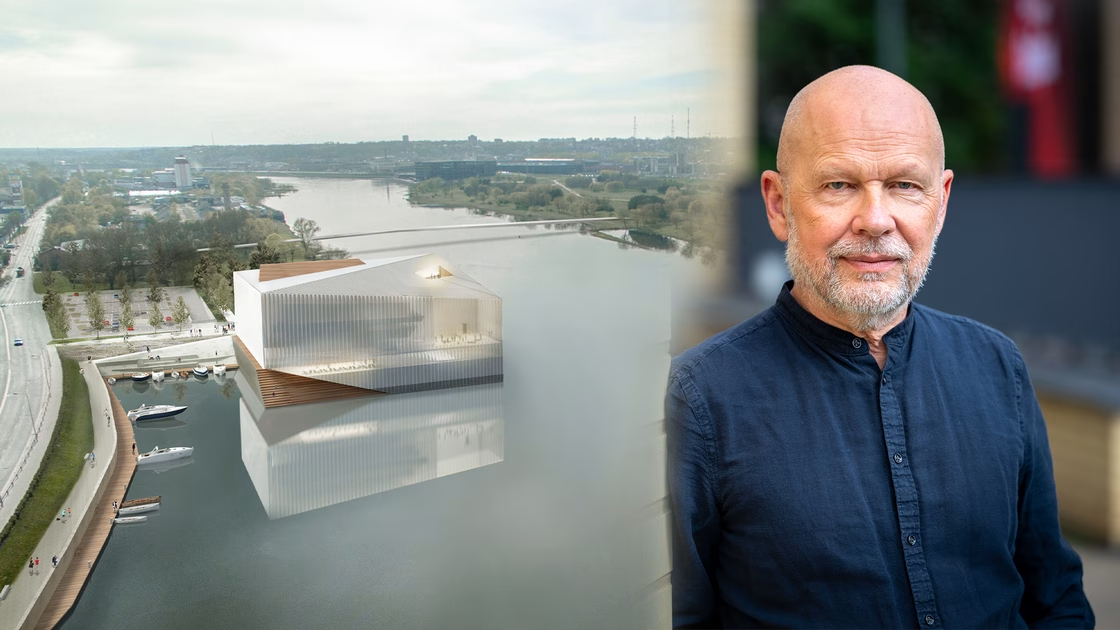
Rolandas Palekas, laureate of the Lithuanian National Culture and Art Prize, founder and head of „Paleko architektų studija“, shared his thoughts on architecture, intuition, Kaunas’ identity, this exceptional project, and future prospects.
About Kaunas’ identity and future city building
“No one will take away Kaunas’ status as the spiritual and mental center of Lithuanian identity. Kaunas is also the undisputed center of modern Lithuania – and I say this not only in a geographical or transportation sense. If we talk about the city’s face, it has changed significantly for the better over the past decade. We all see these changes. Vilnius also has many changes, but for me, it remains a venerable, mysterious historical center of Lithuania,” Palekas describes Kaunas.
According to the architect, creating a city for the future is a collaborative effort. “An architect’s work is in contact with different fields, professions, and people. In no way is it a one-person job. We know that we are building for people, so their feelings and opinions are very important, as the city belongs to everyone. If you can do better right now, so that others can enjoy it for decades to come – do it,” he emphasizes.
Architecture as a lifestyle and the role of intuition
Palekas compares architecture to basketball, stating that in both fields, one must first work hard on defense, and only occasionally hits a three-pointer. “You work, you sweat, and only occasionally are you rewarded with that three-pointer. Such moments make up only a very small part, but that’s exactly why they are so sweet,” he says.
Regarding intuition, Palekas believes it is crucial, especially in the discovery phase. “Of course, I trust it. However, intuition has two dangers – it is quite difficult to distinguish it from repetition and taking the easiest path. With many years of experience, this feeling develops naturally, as you have already been through similar situations. But here lies the danger – starting to repeat yourself. This becomes uninteresting first to yourself, and later to others,” he explains.
He further elaborates on the role of intuition in his work: “My intuition is most important at the moment of discovery. Sometimes, no matter how many sketches or drawings you look at, you feel that something is wrong, even if you can’t explain it sometimes. Then intuition kicks in. You intuitively understand that you don’t need to sketch anymore and you have to choose this particular path, even if you don’t have a rational explanation yet.”
Palekas also touches upon the challenge of reconciling intuition with rationality. “Today, everything is wanted to be calculated, measured. You always have to prove and justify your decisions. But how can you justify intuition? It is primarily justified by faith. Then the question arises – do others trust me enough? Of course, in the end, I still have an objective explanation for my choice,” he states.
He advises against relying solely on pre-existing knowledge: “It’s important not to rely on preconceived knowledge. Even if you think you know, don’t think it will save you. It only leads to automatic blocking and arrogance. Knowledge is very ephemeral, as you can never be sure if you really know something.”
The M. K. Čiurlionis Concert Center and its connection to the Nemunas
The idea for the M. K. Čiurlionis Concert Center to engage with the river stemmed from searching for the essence of Čiurlionis himself. “When it was announced that the concert center would bear this name, we realized that we had to find a connection with him – with Čiurlionis. I remember when the whole studio went to the site, we walked along the right and left banks of the Nemunas. At that time, the water level was higher than usual, and it reminded me of a huge mirror. Then I realized that the building rising in this place should not be very large – it would be surrounded by a green, subtle environment, homesteads, but due to its reflection, it could grow larger,” Palekas explains.
He recounts the thought process: “The question arose, how to create a unique building that would not overshadow the environment with its scale. And so we ‘hooked’ onto the mirror effect. It strongly resonated with me with one of the most memorable paintings by Čiurlionis – ‘Serenity.’ It features a very clear reflection of water. And so the idea was born to create a building that would descend into the water.”
Regarding concerns about the curved glass facades of the concert hall, Palekas is now more optimistic: “Today, I am more optimistic about this issue, and I am glad that everything is moving forward. It is worth remembering that the success and result of quality consist not of tens, but perhaps of hundreds of small good answers.”
Creating a vibrant public space
For a space to truly “breathe” and not just be a beautiful building, Palekas emphasizes the need for people to feel comfortable there. “First of all, you need people who feel good in that space. A pedestrian bridge is currently being built, which I believe will give a great impetus to this place. But that alone will not be enough. A very important and attractive ecological movement route along the left bank of the Nemunas, right by the water – from Vytautas Bridge to Čiurlionis Bridge – is essential. On the left bank of the Nemunas, it will naturally connect with the Nemunaičiai quarter, and the center will be easier to reach from Nemuno Island. Then all that remains is to properly direct the public path itself so that people not only cycle or walk past but also have a reason to stop,” he suggests.
The significance of the Nemunas River
Palekas highlights the growing integration of the Nemunas River into Kaunas’s city center, making it a connecting element rather than a dividing one. “As always, in every project, you look for a strong urban idea. In this case, we decided to quite resolutely change the shoreline, because looking at this place, we realized that we had to create a small harbor. We wanted it to be possible for someone, for example, in Kulautuva, to get into their boat, come to a concert, and return home afterwards. Boating is growing rapidly. I believe that in the future, more and more towns will have their own marinas and water transport. I want this concert center to become an integral part of the city’s image as an inseparable part of Kaunas, and for no one to even think that it might not have been here,” he states.
The Nemunaičiai Quarter and the approach to the river
The Nemunaičiai quarter is often cited as a prime example of the city turning towards the river. Palekas explains the core idea: “The dialogue between the river and the city is not close to me alone. The ideas being realized now were born from discussions with my Kaunas colleagues back in the initial stage, during the vision creation – how the left bank of the Nemunas should be treated. We have long talked about cities needing to turn towards their rivers. In other words, attractive, pleasant approaches to the water’s edge must be created. Highways and wide streets on embankments are for cars, not people, and that is bad. This idea had been in the air for quite some time. When we had the opportunity to design buildings on a plot on the bank of the Nemunas, not separated from the river by any street, we did not doubt that we had to seize this opportunity and continue the direction chosen in the vision.”
He elaborates on the design approach: “That direction could not have happened otherwise than by trying to bring people as close to the water as possible. Therefore, the buildings themselves descended right to the water’s edge. The pedestrian promenade, paths, benches, ground floor terraces – all this came closer to the river. We even shaped the cross streets with a slope towards the water, like in the historical part of Kaunas near Vytautas Church. Walking down the street, a person feels that they are approaching the water, they see it. We were inspired by Kaunas itself in this place. Such seemingly small measures ultimately create the feeling that you are living on the water.”
On winning architectural competitions and facing setbacks
When asked about the feeling after winning an architectural competition, Palekas says, “First of all, of course, there is joy: ‘Wow! Yeah!’ Of course, the emotion depends on the nature of the competition, who is judging the work, who the competitors are, so the joy always has different shades. You realize that the won object will be large, long-term, probably built in stages, then you prepare for a long process. However, you still don’t know when further negotiations will begin and whether they will begin at all.”
He recalls a period in Kaunas: “There was a time in Kaunas – perhaps ten or even twenty years ago – when competitions were held, winners were chosen, but in the end, nothing was realized, and the projects remained unimplemented. That was already common. When we won the competition for the M. K. Čiurlionis Concert Center in 2017, I had the exact same doubt. Fortunately, the doubts were not confirmed.”
On not winning, he states, “I definitely analyze, try to understand, and give myself an account. But this is probably not specific to architects alone – it’s more about different types of people. Some look for reasons for failures elsewhere. Others ask themselves: ‘And what can I do differently next time to win?’”
Reflecting on past projects and comparing work
Palekas admits to always seeing ways to improve past projects: “Absolutely. I probably couldn’t say there is even one realized object where I wouldn’t see today what I could have done differently or what other decision I could have made. However, I try not to think about it too much. Each project is the result of its time.”
Regarding comparisons with other architects’ work, he says, “I observe what is happening around, how cities are changing, but I have never compared myself or my work with other architects. In fact, I never even had the desire to do so. Of course, various thoughts arise sometimes, not always pleasant ones. Every time we start creating, we start from a blank page. We try to find the best answer for the given place, under the existing circumstances. After a long and intensive process, the result appears, and then there is no point in comparing it with others.”